

Motors : Converting kW to HP
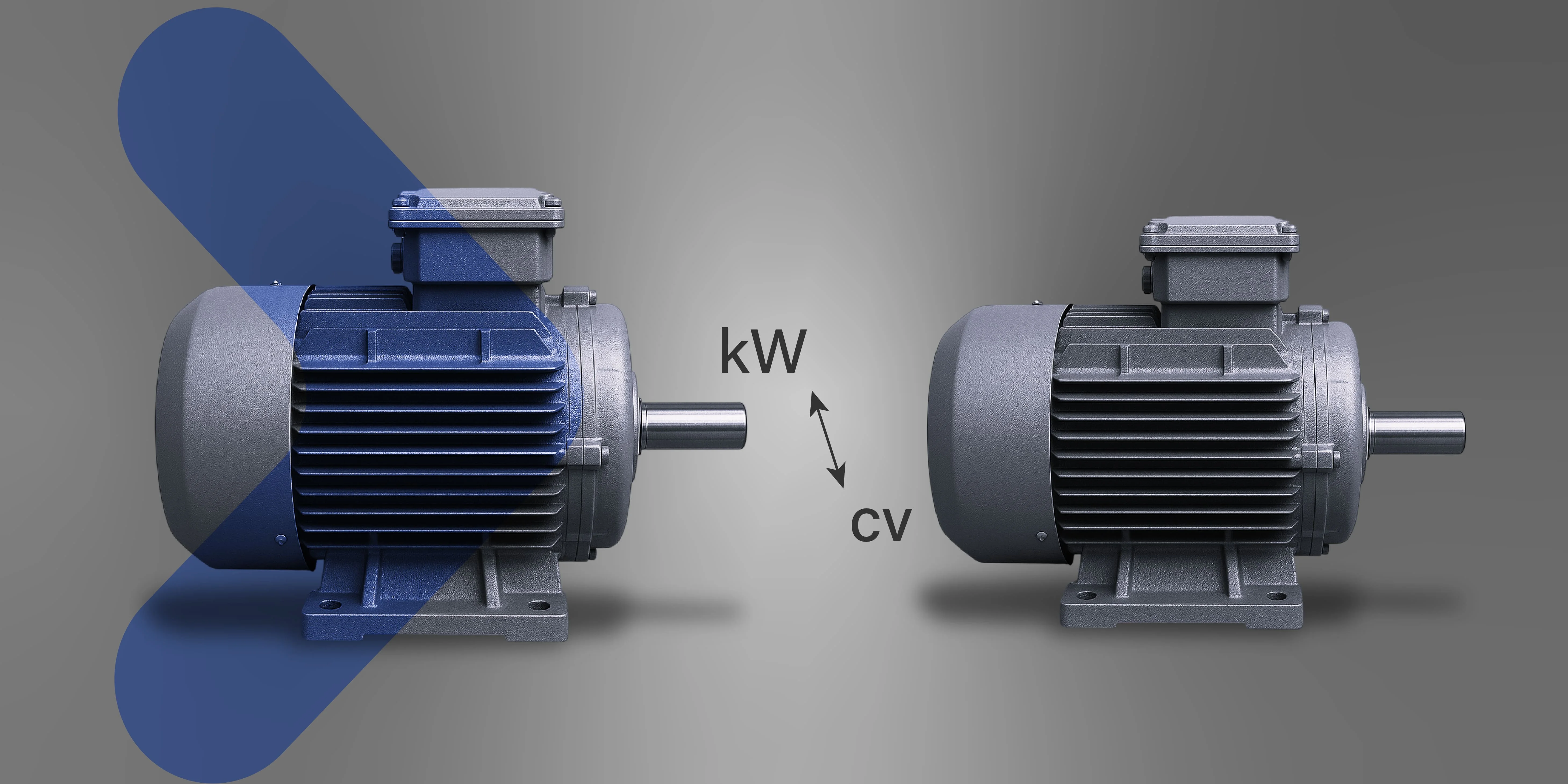
How to Convert kW into HP for Your Industrial Electric Motors and Gearmotors ?
In industry, every detail matters when it comes to choosing or replacing an electric motor. Converting kilowatts (kW) into horsepower (HP) is a key step to properly size your equipment.
Understanding this equivalence helps avoid costly mistakes, improves energy efficiency, and ensures the reliability of your installations, whether they use three-phase or single-phase motors.
In this article, we provide the simple kW ↔ HP conversion formula, a practical table, tips on how to select your electric motors and gearmotors, as well as a clear FAQ answering the most common questions.
Why is Converting kW into HP Essential in Industry?
In the industrial sector, motor power determines:
- machine performance,
- energy consumption,
- the lifespan of installations,
- and maintenance costs.
However, depending on manufacturers and countries, motor power may be indicated in kW (kilowatts) or HP (horsepower). Conversion is therefore essential to make accurate comparisons between equipment.
Concrete Examples
- When replacing a worn-out motor, it is crucial to check the exact equivalence between the old motor (expressed in HP) and the new one (given in kW).
- When purchasing a gearmotor, supplier catalogs may sometimes list power in kW, while your internal technical sheets are in HP.
The Simple kW ↔ HP Conversion Formula
The conversion is straightforward and only requires multiplication:
- 1 kW = 1.36 HP
- ►1 HP = 0.735 kW
Example:
- A 5 kW motor is equivalent to about 6.8 HP.
- A 10 HP motor corresponds to about 7.35 kW.
Practical tip: Keep in mind the formula Power (HP) = Power (kW) × 1.36.
Practical Conversion Table from kW to HP for Industrial Motors
| Power (kW) | Power (HP) |
|---|---|
| 0.75 kW | 1.02 HP |
| 1.5 kW | 2.04 HP |
| 3 kW | 4.08 HP |
| 5.5 kW | 7.48 HP |
| 7.5 kW | 10.2 HP |
| 11 kW | 14.96 HP |
| 15 kW | 20.4 HP |
| 30 kW | 40.8 HP |
| 75 kW | 102 HP |
Power Differences Between Three-phase and Single-phase Motors
A single-phase motor is generally used for small power ratings, while a three-phase motor is preferred for heavy-duty industrial applications.
- Three-phase motors offer better efficiency, more stable torque, and a longer lifespan.
- Single-phase motors are suitable for workshops and small machines but reach their limits above 3 kW (≈4 HP).
Typical Use Cases
- Three-phase motor 15 kW (≈20 HP): industrial conveyors, pumps, heavy-duty fans.
- Single-phase motor 2 kW (≈2.7 HP): light machine tools, small workshop pumps.
How to Choose an Electric Motor or Gearmotor Based on kW/HP?
When choosing a motor, it is not enough to rely only on the kW ↔ HP conversion. You must also take into account:
- the required torque,
- energy efficiency,
- the power factor,
- the rated speed (RPM),
- and compatibility with your electrical installation.
Example:
A 7.5 kW motor (≈10 HP) may be sufficient for a standard conveyor, but a more demanding application will require an 11 kW motor (≈15 HP) with higher torque.
Common Mistakes in Conversion and How to Avoid Them
- Confusing mechanical HP (used in industry) with fiscal HP (used in the automotive sector).
- Forgetting that motor efficiency can reduce the actual power available on the shaft.
- Oversizing a motor “for safety”, which leads to unnecessary energy overconsumption.
FAQ – kW ↔ HP Conversion
What is the formula to convert kW into HP?
1 kW = 1.36 HP.
How many HP is a 5 kW motor?
5 kW ≈ 6.8 HP.
Why do we use kW in industry instead of HP?
The kilowatt is the official international unit (SI), more precise and standardized.
What is the limit for using a single-phase motor?
Beyond 3 to 4 kW (≈5 HP), it is preferable to use three-phase.
Conclusion
The kW ↔ HP conversion is simple, but it is crucial to properly select your industrial electric motors and gearmotors. Whether for heavy-duty applications with three-phase motors or smaller machines with single-phase motors, properly sized power ensures performance, durability, and energy savings.
Are you looking for an electric motor or a gearmotor adapted to your industrial installations?
Contact TEXIME to discover our selection and benefit from our team’s expertise in sales, maintenance, and repair.